Plurking or Twitter : http://tinyurl.com/5ler8m Philips Massager, very cool!

Share your Favourite Creation Moment on Lego’s 50th Birthday!

Industrial Design
Jan 30, 2008

A warm welcome to you dear reader! If you have not already, why not subscribe to my RSS feed, or get my latest thoughts on Industrial Design in your Email Inbox for free?

Thanks for visiting and please keep in touch? ~ D.T.

Happy Birthday Lego!

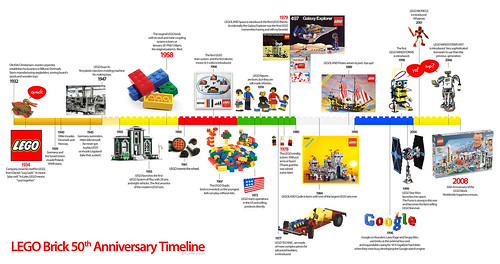
lego-brick4-timeline
Image From: Gizmodo. Click on the image for a larger version.


Being extra busy early this week, I totally missed taking a “moment” on January 28 to wish Lego a Happy 50th Birthday! Check out the very cool time-line above created by Gizmodo, and their collection of “Best Lego Sets in History“!

xwing-vs-tie.jpgBeing a child growing up in the 70’s and 80’s, my favourite sets would have to be the LEGO Star Wars collection, which I started collecting but gave up when I discovered the scope of product range and all the different boxes I had to buy! I also loved the Lego Technic range but could never afford buying any.

After all these years, I can still remember my favourite Lego creation moment. I must have been at least 4 or 5 years old. One afternoon, I decided I wanted a gun to play with. (Don’t ask me why!) Not having any in the house, I proceeded to make one out of Lego blocks. It was a pretty simple design in sort of a capital “F” shape. I was pretty proud of myself, and proceeded to run around the house “shooting” at things. However what really made me mad, was the handle kept breaking off. You know Lego joints. Still breaking off, even after I stomped it with a heavy object, I proceeded to glue the joints up. Needless to say, my mom was not pleased!

What about you? What’s your favourite Lego moment? I would love reading about it!

Anyways before you go, do check out some very interesting Lego trivia as compiled by the gadget wizards at Gizmodo:

• There are about 62 LEGO bricks for every one of the world’s 6 billion inhabitants.

• Children around the world spend 5 billion hours a year playing with LEGO bricks.

• More than 400 million people around the world have played with LEGO bricks.

• LEGO bricks are available in 53 different colors.

• 19 billion LEGO elements are produced every year.

• 2.16 million LEGO elements are molded every hour, or 36,000 per minute.

• More than 400 billion LEGO bricks have been produced since 1949.

• Two eight-stud LEGO bricks of the same color can be combined in 24 different ways.

• Three eight-stud bricks can be combined in 1,060 ways.

• There are more than 915 million combinations possible for six 2 x 4 LEGO bricks of the same color.

• 7 LEGO sets are sold by retailers every second around the world.

• The LEGO bricks sold in one year would circle the world 5 times.

• 40 billion LEGO bricks stacked on top of one another would connect the earth with the moon.

• LEGO bricks are so much more than just toys. They are used in classrooms from preschool to university level to teach everything from math, language skills and science to engineering and technology principles.

• The LEGO brick has inspired generations of innovators, like Jonathan Gay, inventor of Flash.

• World-renowned author Douglas Coupland believes the LEGO brick represents a “language in itself.”

• A January 2008 Google search produces 57.6 million references to LEGO bricks.

• There are 55,600 LEGO videos on YouTube.

• Google co-founders, Larry Page and Sergey Brin, used LEGO bricks to build the external low-cost and expandable casing for 10 4GB hard disks when they were busy developing the Google search engine (today, they have reportedly been used in Google’s college graduate recruiting exercises to test potential candidate’s creative horsepower).

Do these Award Winning Designs Infringe Patents?

Industrial Design
Jan 28, 2008

An interesting discussion between KK, the designer of the Chronotebook, and Scott a designer cum patent agent, has highlighted a potentially huge problem with concept design awards such as Muji Awards 02 and Red-Dot Concept.

Should the awards jury conduct patent searches on the winning products? And if a winning product is found to infringe a patent what happens then? This problem can only multiply as, in the recent years, there have been a huge growth in numbers of such awards, so much so you could enter one almost every month! Fortunately as I know KK personally, I do not doubt his integrity or his design ability to independently come up with a similar concept.

Out of curiosity, I have posted the images of the award winning designs and the supposed patents they infringe. After the images, you can find a quote of Scott’s well articulated discription on what does or does not infringe a patent so that you have it all in one convenient place. Do take study the images and the links to the patent descriptions, as I am interested to know your opinions on this matter?


Muji Award 02 Gold Prize: Towel with Further Options
By: NIIMI [Takuya Niimi/Yuki Niimi] (Japan)
Muji Award 02 Gold Prize: Towel with Further Options


Patent 5004637: Sanitary tearing towel
By: Chuen-Rong Liao
Sanitary tearing towel


Muji Award 02 Judges’ Prize: Chronotebook
By: Wong Kok Keong
Muji Award 02 Judges


Patent 6593942: Event programming guide
By: Dennis Bushmitch et al
Event programming guide

First, let’s take a look at your daily planner. From a patent point of view, you may be able to capture some patent protection on some specific features, such as the daytime and nighttime indicators, but since the concept of using the graphic of a clock to graphically convey information about the analog clock is shown in the prior art (the ‘942 patent), you will have a heck of a time getting meaningful utility patent protection for this item.

To get a patent, the invention has to meet three basic criteria - novelty (is it new), utility (does it have a use) and nonobviousness. This last one catches many wannabee inventions. Your invention could be considered “new” in that no one has applied the above concept to paper-versions of daily planners and it does have utility, but in my opinion, much of what you show would be obvious in view of the ‘942 patent (which uses an analog clock graphic to convey information that relates to particular times about the clock). The fact that the ‘942 conveys this information electronically on a screen doesn’t matter since the concept is shown and also because paper media is strongly connected to electronic displays since the latter followed directly from the former as a means of replacing many of the things we used to do with the former.

Also, clocks are known to be made from chalkboard so that the user can write appointment information directly on the surface in the same way, using the clock graphic as a means of conveying the event about the clock (I’ll send you an example of this to your email).

With regards to the towel, I respect the “spirit” of the design, but the patent office looks at structure of an invention and what a patent specification teaches to one of ordinary skill in the art. In this case, the prior art teaches that a towel may be made with a tear-line so that a user can tear off a piece of towel. Even if the inventor states a different reasone why the user should tear it off (because one section has been used and should be thrown away), it doesn’t matter since both towels include guide lines or tear lines meant to remove one section of the towel from the larger towel. The structure is similar. The fact that the MUJI version offers only guidelines instead of pre-cut lines could be patentable since the strength of the towel is not compromised and also, the MUJI towel provides reinforcement along those guide lines so cuts won’t fray. My point here is that the concept of doing this is known, the finer details may be new.

Interesting food for thought on your next project eh? It is for me, as this has kept me awake to 2.51 am!

Finally a PC that Every Designer has Dreamed About!

Industrial Design
Jan 26, 2008

napkin_pc.jpg

Check out this very clever Napkin PC designed by Avery Holleman that is perfect for collaborating designers. Using e-ink and RF technology it allows designers to draw in colour and skip the very tedious stage of transferring the sketch into a digital format.

Just perfect. Hang on I said that already! But it really is, just perfect for designers and how we need our computers to function during our idea creation process.

Avery has done a great job illustrating the design in a scenario based presentation, so much so that I’ll let the images do the talking. (Note to Design Students: this is how a good scenario story board should be done!)

napkin_pc2.jpg

napkin_pc3.jpg

napkin_pc4.jpg

napkin_pc5.jpg

napkin_pc6.jpg

napkin_pc7.jpg

napkin_pc8.jpg

napkin_pc9.jpg

napkin_pc10.jpg

If anyone has a link to Avery’s website or portfolio please let me know?
Edit: Check out Avery’s other portfolio work here and fixed his mis-spelled name. Thanks Mike and apologies to Avery for the typo.

Via: My friends from Yanko Design

Good Design Award 2007!

nakamichi-electrostatic.jpg

What a nice way to end 2007 and roll into 2008 with a flying start!

My team and I have won a Good Design Award 2007 from the The Chicago Athenaeum: Museum of Architecture and Design for our Dragon Electrostatic Speaker Product Range. This product was also recently featured in Wired Magazine issue 15.03

This win was particularly sweet, as it was a product that we recommended, pushed, and developed as part of our ongoing research into trends, consumer markets and technology. This speaker is also a cumulative milestone example of our evolving design language strategy that I had mapped out for the brand and product category about 3 years ago.

gd.gifFor the 2007 edition of GOOD DESIGN, The Chicago Athenaeum received hundreds of applications from 6 continents contributing to the international importance of the historic GOOD DESIGN Awards. Over 400 products and graphic designs were selected by a distinguished jury of recognized architects, designers, and authorities in the design world for recent designs worthy of the Museum’s GOOD DESIGN Award, attesting to the design energy, vitality, and current innovation in global design today.

This year’s edition was the “Corporate Who’s Who” worldwide: 3M., adidas International, Apple Computer, Bang & Olufsen, Black and Decker, BMW AG., Boeing Corporation, Robert Bosch, British Airways, DaimlerChrysler, Eastman Kodak Company, Electrolux, Epson America, Festo AG., Ford Motor Company, Fujitsu Limited, General Motors Corporation, Harman Kardon, Herman Miller, Hewlett Packard, Intel Corp., Knoll, Inc., LG Electronics, Liz Claiborne, Inc., Logitech, Lutron, Melitta, Mercedes-Benz, Microsoft, Olympus, Owens Corning, Samsung, Siemens, Sun-Disk, T-Mobile, Tupperware, Unilever, Villeroy + Boch AG., and Whirlpool Corporation.

It look like that we are part of a very nice cohort of designers and companies. Also we are 1 of the 6 Good Design Awards that was given out to designers and manufacturers from Singapore. Still along way to go compared to the United States’ 270 awards haul, but I think this is a great start for the Industrial Design Industry in Singapore.

Well our 5 minutes of fame is up, so back to work! Heh-heh.

(Do note: This speaker was recently renamed and repositioned as part of the Nakamichi’s iconic Dragon range.)

How I Simplified My Life and Became a More Efficient Designer

Designer Musings
Fitness

Jan 21, 2008

What a Mess!

About 5 or 6 months ago, I decided that I needed to simplify my life.

Due to a lot of diverse interests and that little bit of an overachiever in me, I have a bad habit of taking on and doing more than I can actually handle. Furthermore, the fact that I tend to lose interests in things very quickly or jump around on different projects does not help me one bit at all. Coupled with the stresses of my job, I was just flat out overloaded!

Mentally I was stretched and constantly tired. This was because I often had anywhere from 15 to 20 projects to attend too at any one time. My fitness went down hill as it became a vicious cycle of my mental tiredness preventing me from getting out of the house for exercise.

As a result I got nothing much done and learnt a painful lesson that I, like many other humans, do not multi-task very well.

I decided at that time, that I needed to simplify my life by closing up as many different projects as possible and, quite literally, focus on a preferred handful. The net result was that, instead of less, I was getting more things done at a reasonably good rate. Why it worked was loose ends and open issues have a tendency to take fuel away from your mental engine, and this means a reduction in the all important focus and concentration in getting things done.


The Creativity Cycle

Creativity Cycle

I have currently juggle about 5 to 6 different projects (both design and non-design related) running, essentially cutting back to about a third of what I used to do. I find I can handle and work with this number of projects and my productivity has sky rocketed. This balance in the current number of projects keeps what I like to call the “Creativity Cycle” turning. This means that I am busy enough to keep my creativity flowing, but it also allows me time to breath or reflect on the creative work, which keeps the “Creativity Cycle” going even more.

Brian Clark, from Copyblogger, wrote about a similar concept in his article called “The Content Crossroads: Supernatural Success at the Intersection of Ideas“. In that article, Brian uses the example of how the Medicis, rich merchant families in Italy in the 17th century, created a creative explosion by allowing the ideas of different people and projects to feed off each other.

By attracting talented souls from so many different fields and cultures, the Medicis caused these varied artists and scientists to come in contact with one another, trade ideas, and discover the intersections that allowed for giant leaps in creativity and innovation.

The trick here is to ensure you are sufficiently loaded for this “Creative Cycle” to happen, but not to be loaded until you are burnt out.


Keep it Simple

I often find to start this “Creativity Cycle” moving, I need to be in a good frame of mind. To do this, each of my 5 projects needs to be distilled down to its bare essence so that I instinctively know what to do at any one time. My rule of thumb to keeping things simple is to describe what you need to do in 1 clear sentence.


Work is Never Ending

We need to understand that the concept of “work” and doing it, basically means that it will never end. There will always be something new that crops up that needs your attention. It is how you manage it that matters.

Really this 5 or 6 projects are the only ones I can efficiently handle at anyone time. Just like you would managing a design project, if your capacity is full, you would either not take on any more work or it will be put it on a waiting list. Why should this not be the same for your personal life? So do ensure that one project is completed or closed before you take one another.


How did I get this magical number 5?

At this time you are probably wondering, how did I get this magical number of juggling 5 projects at any time? It first started out as trial and error, but later I discovered that Giorgio Armani, before me, has also drawn very similar conclusions. Yes that Giorgio Armani.

It was a surprise to find out that Giorgio Armani had built his multi-million dollar fashion empire on this same principal. He believes that he can only work on 5 projects at any time. No more no less. It is also no coincidence that there are 5 working days a week, and that he spends each day just focusing on 1 of his projects, and doing nothing else. As a result of staying focused and keeping his work load simplified, he claims he was able to achieve success without ever having work late or on weekends. Now, you can take that to the bank!


Join the simple life!

I like to close this post with a tip of my hat to Zen Habits and Think Simple Now. My decision to simplify my life was due to in not small part the influence these two blogs had on me. Thanks Leo and Tina, you have been a great inspiration and a big help in making me a much more efficient designer.

Jonathan Ive, Design Genius or Something Else?

Industrial Design
Jan 19, 2008

rams-ive.jpg
Image Source: Gizmodo

According to Gizmodo there is an uncanny resemblance between the great work of Dieter Rams to the work of Jonathan Ive head of Industrial Design at Apple.

When you look at the Braun products by Dieter Rams—many of them at New York’s MoMA—and compare them to Ive’s work at Apple, you can clearly see the similarities in their philosophies way beyond the sparse use of color, the selection of materials and how the products are shaped around the function with no artificial design, keeping the design “honest.”

Jonathan Ive’s dedication to “honesty” and “simplicity” in design pays great homages to Dieter Rams’ 10 Commandants in Design, and is something that Japanese design great, Naoto Fukasawa, indicated was his major design influence as well. Rams’ 10 Commandants was also recently printed in Wallpaper Magazine’s September 2007 issue, and was something that I wanted to write about but totally forgot! Here they are, in brief as extracted from Wallpaper Magazine:

Dieter Rams 10 Design Commandments
Good Design:
1. is innovative
2. makes a product useful
3. Is aesthetic
4. Helps a product be understood
5. Is unobtrusive
6. Is honest
7. Is durable
8. Is consistent to the last detail
9. Is concerned with environment
10. Is as little design as possible

Anyways check out the complete comparison at the Gizmodo site, some of which are so similar that saying it “was inspired by” is actually pushing it.

Braun T3 pocket radio and Apple iPod
ipod-comp.jpg
Image Source: Gizmodo

What do you guys think?

Do you think Jonathan Ive is a design genius? Or was he suitably inspired? What about the similarities in design and detailing between Apple and Braun? Are Apple products a result of a close tribute to Dieter Ram’s design thinking? If so what about Naoto Fukasawa, who also follows closely to the teachings of Dieter Rams, but yet his work has a unique character of its own? Shall we discuss?

MacBook Air : Disgustingly Thin

Industrial Design
Jan 16, 2008

mba1.jpg
mba3.jpg


mba2.jpg
Disgustingly thin images from apple.com

I hate to say it, but I think its time for me to cross over. Not because of its disgustingly thin form factor, but the way it is optimized for wireless network and the increased usability in its touch pad that is very similar to the gesture features found on the iPhone. This gestural control is going to be a trend setter.

With its relationships with Intel and other vendors, they have essentially managed to push the envelope of engineering and manufacturability, and thus able to deliver this thing beauty to all of us. It is interesting to hear that “challenge” their vendors to push the limits, something very rare in these days of outsourcing. This, I believe, is a strategy that other product development companies and component vendors can learn from to make better products.

Finally I have always believed that is all you need on a note book, screen, HDD and a damn good wireless connection for all your online needs. (I’ll keep my ugly pc for my 3D stuff!) Apple has shown that they understand this, and delivered a product (with all software included, iLife etc.) that is easy for converts to move over.

But there are a few downsides though. Firstly don’t get conned on all that marketing hype about the battery life. Less components means less battery consumption. Not only that, most of their environmental friendly aspects (recycled body, clean PCB etc.) already come standard in many other electronic products. Furthermore a smaller product also means smaller packaging, DUH! The reality though is a environmentally friendly packaging comes in the brown box with no external printing. However all in all, it comes together in a pretty good Eco package and a decent effort in responds to getting slammed by the Green groups recently.

If you have not already, check out its greatness at the official Apple Macbook Air website. Time to get your MBA?

Edit 3: Fantastic Macbook Air Parody!

Edit 2: If you are like me, are interested in Steve Job’s Keynote at MacWorld, but don’t have the 90mins it runs for? Check out Mahalo Daily’s 60 second edit! Everything important is in there. Via: Techcrunch

Edit 1: Additional information added.

Friend Wheel : A Visual Representation of How my Friends are Connected on Facebook

Designer Musings
Jan 15, 2008

wheel-s.gif

I’m always a sucker for cool graphical representations of data such as the Website Graph Generator. Thus one of my favourite reads is “Information Aesthetics“, a website focusing on such data visualizations.

Therefore I recently had a pleasant surprise when I discovered the Friend Wheel application on Facebook. How it works is that, firstly it gathers all your Facebook friends and how they are connected to each other. Next it then generates a cool graphical wheel that visually shows how we are all linked. Furthermore if you are a little more itchy, the application has the ability to switch data parameters and create a visual wheel for your Networks, and a selection of random or mutual friends. Do check it out for you Facebook addicts!

8 Important Consumer Trends to Look Out for in 2008

Fabbing
Jan 13, 2008

Early this year I wrote about the Top 5 consumer trends to watch for 2007 and how it relates to Industrial Design. Following tradition, here we go again for 2008, and this time it is a little earlier and hopefully will help all of us be a better prepared in our never ending push to identify, synthesize and create a product that could become the next big thing.


Once again I am tapping in and responding to the large body of research by Trendwatching.com who graciously shares it with the world in their annual report for 2008. The consumer trends that were identified are very wide ranging and have applications in many areas, but the astute designer will realise a lot of it can be applied in your design programs. In particular if you start your design programs with a scenario base strategy as most of what was discussed is about our culture and habits of tomorrow. Even if you don’t, its just great information to keep for your lateral thoughts.

Here are my thoughts and comments, from an industrial design or product design stand point:

1. Status Spheres

“Here’s something trend watchers, CMOs and other business professionals should be able to agree on: in the end, when dealing with (and selling to) people, everything always comes back to status. In a traditional consumer society, he or she who consumes the most, the best, the coolest, the most expensive, the scarcest or the most popular goods, will typically also gain the most status.”

Selling products as Status has always been big business, and with the polarization of the market place and manufacturers or consumers moving up market, this trend to status will continue to feed each other in a vicious cycle. However designers will need to realise that this does not work with all products as:

As we’ve pointed out many times before, one mistake both trend watchers and brands make all the time, is to assume or pretend that a certain ‘trend’ will affect or be embraced by ALL consumers. No. Remember, in life and in trends: beauty (or ugliness) is in the eye of the beholder.

I believe tt is all about experiences and what is important to your target market. I have always said your consumer may eat premium pasta, drink expensive wine, but drive a Toyota, or worst still buy a $20,000 Home Entertainment system just to watch his pirated DVDs. In-depth study and understanding of your target market’s motivations is the key to unlocking what they find important to their status.

In terms of a consumer group, the status seekers will not only include the Rich. The “Nouveau Rich” (the growing rich middle class in developing countries like China, Russia and Eastern Europe) together with the Baby Boomers and Female market will be important considerations as they now have the money for self-actualization.

Interestingly enough status does not only have to do with money. Trendwatching also identifies other Status Spheres that Industrial Designers can think about.

a) The Transient Sphere: people who strive and seek as many different experiences as possible. Travel, trying new products, I see such consumers fluttering around everything like butterflies.

b) The Online Sphere: People craving an online status or in other words how many Facebook friends or visitors they have to their blog. I expect the internet to continue to be the place for new product launches and limited edition (Internet only?) launches.

c) The Eco Sphere: The Green movement will continue to gain momentum, and making sure your products are green will be a given.

d) The Giving Sphere: Gaining status by giving back to society.

e) The Participative Sphere: Customer made and interaction with your best customers can be a key to great market research and designs. Just don’t let this hinder your innovation.

2. Premiumization

Basically, with more wealth burning holes in (saturated and experienced) consumers’ pockets than ever before, quick status fixes derived from premium products and premium experiences will continue in full force next year.

This is something we started to see in 2007, Leather laptops, scarce electronics (planned scarcity?), limited edition water bottles, limited run toys, First Class Suites etc. I think this will continue to be big in 2008. As they say every product and service will soon have a “premium version”.

How about 2008 being about the PREMIUMIZATION of everything and anything. In other words, no industry, no sector, no product will escape a premium version in the next 12 months.

From the design side, expect modular platforms with “pimped” materials or features, and perhaps an “elite” range product runs. Mass market manufacturers will be struggling to look for differentiation but still maintain their bottom line as their volume calculations are hit. Luxury product manufacturers will also struggle as they pull no stops in locating the best and most unique features for their status conscious customers and hopefully redefining what is luxury at the same time.

3. Snack Culture

SNACK CULTURE thus embodies the phenomenon of products, services and experiences becoming more temporary and transient; products that are being deconstructed in easier to digest, easier to afford bits, making it possible to collect even more experiences, as often as possible, in an even shorter time frame.

Trendwatching calls it the Transient Sphere on steroids, however to me I think it is more that just about accumulating experiences. Our hyper-consumers are so overloaded with information that there is so much they can mentally process at anyone time. From over styled products visually fighting each other to easy to use products, this Snack Culture will have a huge impact on Design. What “bite-size” products will essentially do is impact in your product’s use experience. Consumers will likely throw your product in to the bin if they can’t figure it out in the first 2mins. As a result try-before-you-buy will be big, and just like Toys, your product better demo well.

4. Online Oxygen

…control-craving consumers needing online access as much as they need oxygen.

I think the effect is pretty clear as I had written in my Amazon Kindle post, products will need some kind of on-line strategy to vastly grow its use experience. It could be about accessing online information like internet radios, or uses the internet as a means to sell the product like limited edition prints or T-shirts. What ever you pick, on line information of your product and using blogs to generate buzz will be the norm for 2008.

5. Eco-Iconic

Over the past few years, the ECO trend has moved from ECO-UGLY (ugly, over-priced, low performance alternatives to shiny ‘traditional sphere’ products and services) to ECO-CHIC (eco-friendly stuff that actually looks as nice and cool as the less responsible version) to ECO-ICONIC in 2008: “Eco-friendly goods and services sporting bold, iconic design and markers, that help their eco-conscious owners to visibly tout their eco-credentials to peers.”

As mention earlier, the Green movement will continuing to gain momentum, influence and thus power, will be something to watch in 2008. Eco design should be something manufacturers can seriously consider as strategic competitive advantage. Furthermore, as going green will be a given, designers should take the next step to be not only aware of the environmental impact of your designs, but to build systems and products that foster sustainable behaviours in consumers.

6. Brand Butlers
This is an interesting idea where brands engage customers by getting involved in their day to day lives. This builds brand loyalty and love that encourages the customer to spread the good news! Designers might like to see how advertisers will position their products together with their customers. I probably won’t say too much more as this is really more of a marketing, advertising or PR strategy.

7. MIY | Make It Yourself

It’s a mainstream trend now, one that keeps giving, with millions of consumers uploading their creative endeavors online, and tens of millions of others enjoying the fruits of their creativity. User-generated content, at least in the online world, has grown from a teenage hobby to an almost equal contender to established entities in news, media, entertainment and craft….the next frontier will be digitally designing products from scratch, then having them turned into real physical goods as well. In fact, expect MIY | MAKE IT YOURSELF (and then SIY | SELL IT YOURSELF) ventures to become increasingly sophisticated in the next 12 months:

Of all the trends we are discussing today, this perhaps has the greatest impact to Industrial Designers. While this trend speaks about the current online MIY trends, and soon to be available physical facilities for customers to make their own, the next step is pretty obvious. Basically if people are making their own products to a specification of what they want, then what is the role of Designers and Design? This is something that should force Industrial Designers to sit up and think about, as it has a huge impact on our future.

While I have touched on this topic in the past with “Fabbing: A primer for Guerilla Design Strategies” and “The future relationship of IP and Industrial Design“, I will soon be exploring this topic in greater depth here as part of my in-depth research paper on this issue. So do stay tuned!

8. Crowd Mining

CROWD MINING: when co-creating, co-funding, co-buying, co-designing, co-managing *anything* with ‘crowds’, the emphasis in 2008 will move from just getting the masses in, to mining those crowds for the rough and polished diamonds. How to do that? Shower them with love, respect and heaps of money, of course.

This is an interesting as it will impact how we do our Market Research for our design programs. Now with communities of people with common interests coming together, it will be interesting to see how companies or people managing such websites take advantage of the “power of the people”.

While it is tempting to create a product that a group of people may want, it may not be entirely correct or successful all the time. We still need to be prudent with our costings and due diligence.

———-

I hope you enjoyed that run down and I wish you a great year of product development success!

Bill Gates says Good Bye

Designer Musings
Jan 10, 2008

This year’s 2008 CES Keynote speech is Bill Gates’ twelfth and his last as a Microsoft Employee (he is still the Chairman though). He says:

“This will be my last keynote. As of July, I will no longer be a full-time Microsoft employee. Since I was 17 I’ve had a full-time Microsoft job.”

Not sure how well this bodes for the future of Microsoft, but his conceptualised this last day at Microsoft with this video that took me a while to find.

Bye Bill and thanks for the memories…and oh, if you were really interested in the content of his keynote speech as well as his technology predictions, check it out Engadget’s blow by blow by the minute coverage.

Via: Pocket Lint and Engadget.