Micro-Blogging via Twitter: Interesting, the Deck Ad Network turned my blog down. Apprently I'm not visible enough in the creative community.

Frog Design’s Earth Day Presentation

Strategy and Management
Posted by DT
Apr 30, 2008

In honor of Earth Day, Adam Richardson, Director of Product Strategy at Frog Design has shared a presentation he gave to introduce Frog Design during the “Design Green Now” panel discussions.

As Adam mentions, comes across a little light little without his supporting talk, but it does give you an idea of what Frog is doing to save the earth. Thanks for sharing it Adam.

I would suggest that you actually view it in full screen size, so that you can make out some of the more interesting details in the presentation. Check it out at Slideshare.

Life’s Like That: Part 1

Designer Musings
Posted by DT
Apr 28, 2008

It has been awhile since I wrote a post that adequately fits into my “Designer Musings” category. In the start-up days of this blog, more than 2 years ago, I had defined this category as “My personal reflection and opinion on Design and the Design Industry”. So as I have not posted in a while I thought that this would be a good time to do some “Designer Musings.”

I often try to keep things here at Design Sojourn less personal, and more factual or educational. But as I don’t really have a personal blog, there is not much of an opportunity for a personal outlet, “blurbage”, or perhaps occasional verbal diarrhea!

Therefore, I have found it very therapeutic micro-blogging (read: ranting or raving) about my personal experiences with design on Twitter.

Often I find it more powerful to make a 2 sentence statement about Design that gets to a more succinct point instead of penning out a long blog post. Twitter is perfect for this sort of expression.

However there are a few things that I’ve noticed on Twitter that is a problem. When you post something on Twitter, what you are doing is creating a “Tweet” that disappears into a river of news as quick as the time it took you to type the 140 character limit on Twitter. Unless you use some 3rd party Twitter tools to archive your “Tweets” on your blog, there is no real permanence to the things you say.

So just like my Design Sojourn blog content policy or commenting policy, I’ve decided to create a Twitter policy. So do follow me on twitter if you are interested in small nuggets of Design gold, random entertainment blurbs and links to porn. (Kidding on that last bit!)

What will happen here is still the same old Design Sojourn goodness, but I will start to share more of my personal design opinions, experiences and an occasional rant or rave. All in more than 140 characters (but less than 500 words) and all for the betterment of the Industrial Design Industry!

Plus I think it is a lot more permanent doing it here on Design Sojourn, rather than Twitter, and best of all I can get and respond to comments, something again Twitter is not good at allowing you to do.

Well that is all I’ve got for you today, so do stay tuned for the next part when we will talk a little more about how “Life’s like that”, at least from my point of view! :)

Why Sh*T matters in Design. What?

Designer Musings
Posted by DT
Apr 21, 2008

This little video excerpt by Allan Chochinov (of Core77 fame), during his presentation at the PSFK Conference New York 08, talks about his observations he made of his students after he asks them to design the perfect pooper-scooper.

Quote from transcription:

You have to make a lot of shit if you want to create something of significance. The attempt is to “clever” your way to a solution without cranking out a lot of work. You need to give a shit about what you do. Need to make your work personal. In this time of focus groups and user testing, with the tyranny of the user going on, I think we’re starting to commoditize creativity and turning ourselves into problem solving machines and innovation specialists. Forgetting there’s a reason they called us in the first place. The students able to find a place that was personal not only were more successful but they had a lot more fun. Don’t work on shit jobs, only create artifacts and services of value…

Honestly I was a little disappointed, I had expected something different. Perhaps something more insightful? Nothing particularly new here, but at least his delivery is different. Regardless, how many of us have the privilege to decide on the design projects we can take on? I certainly cannot.

Many years ago, I took the steps to work in an industry where we focused on low volumes, long product life cycles, and hopefully better product value offerings. But that is as far as I can go. At least csven can walk away. I certainly can’t.

The reality is many of us designers are stuck in this massive cycle of consumerism. Getting on a soap box and telling the world how designers can make a difference is one part of the story. The reality is the consumer and businesses must change first, as most designers (including myself) are either doing something about it or are waiting for a chance to make a difference.

Via: PSFK, with a pointer from rebang’s twitter updates.

New Era Marketing is all about Joining the Conversation

Strategy and Management
Posted by DT
Apr 16, 2008

One of my big interests as a Strategic Designer, is in the field of marketing, advertising and branding. In particular this whole buzz about new media and its impact on today’s consumers. This is also one of the reason why I started this blog in the first place. I always believe, the best way to find out about something is to do it.

From my stand point as a designer, I have always found the consumer behavior part of marketing most intriguing and a very important aspect of the profession of Industrial Design. It is unfortunate that it is not stressed enough in schools in favor of the more engineering requirements. (Which is also equally important.)

Daily, I lament on how it is now getting harder to design products that consumers want. The Internet has influenced how we buy things, and as a result, consumers as we know it have change. Consumers are no fools, and we cannot treat them as such, for example by selling them inferior products tempered by price. Armed with the knowledge derived from the Internet such Uber-consumers (or Pro-sumers as Joseph calls them) have not only the know-how, but the voice to influence how people will see you, your product, and your brand. Times, they are a changing for world of marketing, as we are heading into a word of “new consumerism”

Logically, if Marketing and Advertising has to change, how we study and research our consumers and their behavior has to change as well. Otherwise how are we as designers able to gain critical insight and develop successful products?

Thus late last year when a New Media Marketing blog by Joseph Jaffe that I follow, conducted an experiment called “Use New Marketing to Prove New Marketing (or UNM2PNM in short)” I was very interested. Simply because as a designer I would be now able to better understand this new consumer phenomenon that the consumer electronics business have been struggling to design for in this last couple of years. This phenomenon is basically consumers who are tired of advertising, weary of marketing copy, immune to design eye candy, cynical to product promises and suffering from information overload.

Thus eagerly I signed up and became part of this experiment. The conditions of this experiment was that Joseph would send me and other participants a copy of his Join the Conversation book, and together with his website and the books’ website, we will be able to see and feel first hand the flow and ebb of how consumer see this book. UNM2PNM in its full glory. Very Nice.

However that is just the mechanics, the real “meat and potatoes” of things is actually in the Join the Conversation book. The book itself is an amazing summary of what you might have missed if you have been “living under a rock” since the advent of Social Media and Web 2.0.

While a lot of the terms are not entirely new, especially if you are a serious blogger or a participant in new media, Joseph explains them in a easy to understand and insightful way. To me it even clarified some terms that I had a cursory knowledge of.

More importantly Joseph brings this issue of New Media and how it can be tied back with Marketing. He does this by first describing the Marketing strategies of the past, its mistakes and why it is not working today. Being Marketing trained, I particularly like his description of the “Shot gun approach” to advertising, and the problems with Word-of-mouth marketing. Alot of it had me nodding in agreement.

He also then goes on to describe why the New era of Marketing is all about a conversation with your consumers, and hence the book’s title Join the Conversation. Best of all the second part of the book are Joseph’s strategies and ideas for companies to start having conversations with their customers, and how to take advantage of it.

Unfortunately I am a slow reader, and am about less than half way through the book. This is because I like to read and digest the written work at the same time. But strangely at this time, I sense a great urgency within the book, and that Marketing, Sales, PR and Advertising will need it more that I. As a result the book is instead doing the rounds with various people I know in that industry. (Hi SIL!)

As such, if you are in the above mentioned industry, I urge you to pick this book up ASAP, particularly if you still hold on to your bastion of traditional media. Your job and eventually mine will depend on our understanding of this New Media. My best guess is we have about 6-8 months or less before we go the way of dinosaurs. Yes, it is moving that fast.

An Exercise Born Out of Frustration

Design Tips
Strategy and Management

Posted by DT
Apr 14, 2008

First of all, I like to apologize for the lack of my usual “insanely useful” design articles lately. I have been in the last couple of months really busy resettling back in Singapore. Not only that, work has been really busy as we have kicked off a good year of product development. Lastly as the title of this post alludes to, I have been working on something that I would like to give back to the Design Industry that I love so much.

>Think>Draw>Make> (at www.thinkdrawmake.com) was something that I have been thinking about for quite a bit. This was really born out of my frustration seeing designers both young and old:

  • Think & Draw but don’t Make
  • Draw & Make but don’t Think
  • Think & Make but don’t Draw

Perhaps it is about the failure of educators to teach design in such a manner, or maybe students just forget that 3D does not tell you everything. I don’t really know. However what I do know is this basic principle is vital for creating any form of good design as the reality is this process naturally weeds out the crap from good.

As a result I decided to create this Design Sojourn Mini-Site as a living reminder for everyone of this basic design process, and for the betterment of our Design Industry. A call for designers to be more self-critical and have “Zero Tolerance for Poor Design”.

No only that, as I am also a big fan of design visualizations, I have open this site to anyone interested in submitting their interpretation of what their favorite design process is. It does not necessary have to be about Think/Draw/Make per say, but about what they think it could be. This then opens the many design processes to dialogs and debate. Hopefully we can all learn something from this. Regardless it would make a great repository of process visualizations for your next design presentation!

So I like to encourage all design sojourn readers, designers and non-designers, in fact anyone who uses design and creative principles at work to submit their version of their Design process. Not to worry, there will be full kudos to the designer, and the site will be 100% Ad free. It is a public service announcement after all.

If you are interested in submitting your interpretation, do email me a 550 x 450 pixle Jpeg to: dt [at] designsojourn.com

I look forward to hearing from all of you soon! Please keep in touch.

11 The Beautiful Game of Foosball

Industrial Design
Posted by DT
Apr 10, 2008

11_thebeautifulgame_intro_small.jpg

Donn, a former student of mine, and an Intern at Gro Design recently sent me notice of a very cool foosball (link to what is foosball?) project he was part of. Finally someone is sitting up an taking notice!

11_thebeautifulgame_atmosphere_1_small.jpg

As an object, the football table has lacked serious design attention in recent years. While new football stadiums built in recent years have a strong
architectural and sculptural beauty, football tables remain less desirable objects as their cost-driven appearance no longer fits in with the designed
landscape of modern interiors.

‘11’ breaks with this tradition by creating atmosphere through form, colour, material and subtle use of light, bringing a heightened sense of drama
and excitement to the game.

11_thebeautifulgame_makingoff_17.jpg

11_thebeautifulgame_architectural_1_small.jpg

11_thebeautifulgame_players_1_small.jpg

11_thebeautifulgame_makingoff_1_small.jpg

This design was a collaboration between Gro Design and Tim modelmakers and will be exhibited during the Milan Design Week 2008, 16th - 21st April, Via Forcella 8, Milan, Italy.

Great stuff guys and Donn, thanks for the heads up.

For more information, photos and video of the model, check out the official site: 11thegame.com

Philips “Design Probes” into our Future

Industrial Design
Meta Design

Posted by DT
Apr 07, 2008

In the same spirit as Visions of the Future Project, Philips generously shares with us their research findings of what our possible lifestyles could be in the era post 2020. Called Design Probes it is:

…a dedicated ‘far-future’ research initiative to track trends and developments that may ultimately evolve into mainstream issues that have a significant impact on business.

The Probes generate insights from research in five main areas; politics, economic, culture, environments and technology futures.

The end result are a range of “narratives”, industrial design concepts and scenarios that are not predictions but instead are meant to stimulate discussion and debate. There are quite a number of projects on display, but the two most recent ones are:

SKIN: Dresses

dresses1.jpg

One of this year’s Probe project areas is SKIN, which examines the future integration of sensitive materials in the area of emotional sensing – the shift from ‘ intelligent’ to ‘sensitive’ products and technologies.

As part of SKIN, we have developed two ‘Soft Technology’ outfits to identify the future for high tech materials and Electronic Textile Development in the area’s of skin and emotional sensing.

The dresses show emotive technology and how the body and the near environment can use pattern and color change to interact and predict the emotional state.


SKINTILE: Electronic Sensing Jewelry

jewel1.jpg

Electronic Sensing Jewelry has been conceived alongside a European project, STELLA, (www.stella-project.de) developing stretchable, flexible electronic substrates that integrate energy supply, sensors, actuators, and display.

Skintile the Electronic Sensing Jewelry further explores emotional and physiological sensing. It is a new genre of product; a generation of wireless, stick-on body sensors that re-define traditional body adornment.

It explores a range of functionalities in new product forms that are playful, sensual, mood affected, bio activity stimulated, and arousal enhancing. It is a semi disposable, bio compatible, non-allergenic, breathable, mass customizable, self contained body worn accessory.

I am glad that a company like Philips understands that sharing their research and ideas is much better as it actually encourages the “seeds” to grow. Sometimes it is better to share than to protect. I find this it makes the design world a much better place to work in. Check out the rest of their ever evolving and growing project list at Philips Design Probes.

Iconic photographs recreated in Lego

Meta Design
Posted by DT
Apr 05, 2008

Photographer Mike Stimpson has recreated some of the most famous photographs of the 20th century. Very interesting as he managed to match the mood but injected a little of his own creativity and wit into them.

Lunch Atop a Skyscraper
lego3.jpg

Original Photo
men.jpeg


Viet Cong Captain
lego4.jpg

Original Photo
nguyen.jpg

Mike says of his Lego recreation of the famous Vietnam war photograph: “The original is somewhat more distressing than the Lego version. It’s the smiley faces that do it.”

Check out the rest of his images at the Telegraph.

Solar Panels Inspired by Leaves

Industrial Design
Posted by DT
Apr 03, 2008

grow-leaves-detail.jpg

grow-leaves.jpg

smit-grow.jpg
Image source: SMIT

It is really Biomimicry at its best!

Samuel Cabot Cochran, as part of his final year thesis, and SMIT or Sustainably Minded Interactive Technology, has developed an awesome Green energy generation device. Obviously inspired by leaves, and aptly named Grow, the product can generate power from sunlight (photovoltaics) and the wind (flexible piezo generator).

Also it’s not a concept, as they have figured it out how to make it:

Each brick has 5 solar leaves which have a very flexible piezo generator at their stem. The manufacturing of these bricks could happen in a roll to roll printing process where PV, conductive ink, and piezo generators can be layered quickly and efficiently. The rolls can then be stamped and formed to create leaves and connection points. Each brick is designed so that at the end of their life cycle the valuable components, i.e. photovoltaic and piezo, can be stamped out and up cycled while the reusable material, i.e plastic, can be up recycled back into the production stream.

This leaf like design also fixes the problems we have with traditional solar cell slabs. It is just not as efficient, and the reason why you don’t see trees in nature that have only one big leaf. Now if we could some how turn the entire shape into that of a real tree…anyway in it’s current incarnation, it is a happy blend of practicality and inspiration from nature.

The other great thing about this design is that it is modular in nature (no pun intended). This means you can create a “wall” of generators as big or as small or in any shape you want! How clever is that? We have finally moved from “Green is Boring” to “Green is Damn Cool!”.

Via: CIID

A Cross-Pollination of Creative Ideas at Blueprint 2008

Blueprint 2008

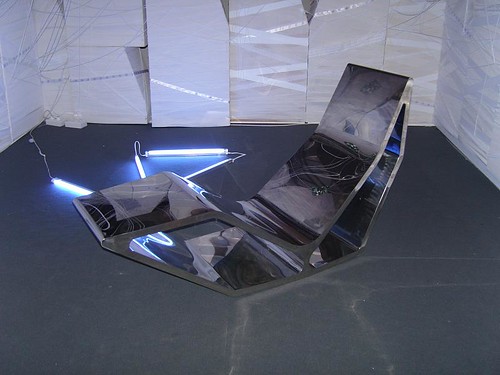
Yesterday, at the height of the Singapore Fashion Festival, I was invited to view a wonderful fashion show that was unlike any other. Called Blueprint 2008, the conceptual show was a result of a cross-pollination of ideas between fashion and industrial designers. What I liked about it was that the work was part sharing and part collaboration of ideas between fashion and product designers, with both inspiring each other to greater heights.

Organized by the Design Singapore Council the objective was as Director Dr Milton Tan said:

“We believe designs are appreciated by their experience in totality. If we can get designers to work more closely together, the experience from the users point of view will be more holistic.”

The exhibition is currently on display at the fashion festival’s Tent@Orchard outside Ngee Ann City until April 6. From April 10 to 28 it will move to the Samsung Flagship store at VivoCity from. For our friends from the rest of the world, the work will be presented at the Milan International Furniture Fair from April 16 to 21, so check it out there!

Meanwhile here were some of the more interesting products on show. Enjoy!

Blueprint 2008

Blueprint 2008

Blueprint 2008

You can find the rest of the fashion outfits and products at my flickr set. However I have to apologize as the images are not the best! I’ve also taken some videos as well to give you an idea of the atmosphere during the show and will get them up here when YouTube fixes its uploading problems.

For more information on this event check out the official press release here.