Design Sojourn’s Brand New Beginning

Kohi Sunrise

Sorry for that cliffhanger of an ending in that last post where I announced that I would be leaving Philips Design at the end of September. I like to be a little dramatic at times and I thought it would be a nice lead in to the story I’m going to tell you today.

So what, you may ask, am I going to do next?

I have spent most of my life working for people, or more accurately, designing for other people and making said people rich! Well not really…but I did decide that it was a time to do something different. Central to this plan, as you probably guessed by now, is Design Sojourn.

If I do a little counting, my Design Sojourn blog has actually been in operation for almost 5 years now! Throughout the history of this website, I have shared my ideas and thoughts on design, bounced these ideas (and sparred) with designers from all over the world. I have even helped and mentored designers whenever I could. I hope such efforts have contributed to the international design industry as a whole and in return allowed me to build some credibility as thought leader in design.

So it is then logical to expand Design Sojourn into other areas beyond just blogging. I plan for Design Sojourn to evolve into a design consultancy and brand management company. Yup, I’m going to be an entrepreneur.

Here are a few more details:

Design Sojourn The Blog

First and foremost Design Sojourn the blog, will continue, but it’s going back to its roots. This blog cut its teeth by helping designers be the best they can be. Design Sojourn was and is all about “How to do good design, and make clever products”. I did, in recent years, evolved this blog into Strategic Design. However I realized that by helping designers become more strategic, it was really still in the same vein of helping designers be the best they can be. Being strategic is the name of the game in today’s design industry.

I have also taken a look at the state of my blog, and I have to say I’m not happy with it. In the recent years, my heavy workloads and family commitments have influenced a drop in the quality of my posts. I had discovered one day that the posts people came to Design Sojourn for were more than 2 years old. Don’t get me wrong, I’m not angry or anything, I have accepted that my priorities and attention were needed elsewhere. I will therefore plan to dedicate more time in writing useful and engaging posts that will make your visit to Design Sojourn worthwhile. Growing Design Sojourn is high on the priority list, with a target of doubling readership in the next six months.


I’m going edgy. Simple but edgy. Oh, and critical too, but constructive critical.less than a minute ago via Twitter for iPhone

Finally, now that I am on my own, I will not be tied down nor associated with any brand. I’m now a Design Rōnin. A master-less designer roaming the world and kicking ass! Sorry, too many Akira Kurosawa movies.

Rest assured that I’m not about to take a “dump in my own backyard”, but do expect a more edgy tone, more rants, and of course, constructive criticism. Not being associated to any brand does provide the freedom to have an unbiased view.

Design Sojourn Consulting

After everything, the unfortunate hash realities of life still exist. We still need to eat and I have a mortgage to pay. This is where things here at Design Sojourn will start to be a little different.

Many companies setup a company then a blog to get them going. I’ve actually flipped this approach on its head by turning my blog into a company, Design Sojourn Pte Ltd. Here is what we do:

Design Sojourn is a multi-disciplinary strategic design consultancy.

We see ourselves as guides or translators for clients and partners in their journey in design that will go beyond products and into services, systems and processes. We are also teachers and students at heart, so we are passionate in building creative environments and improving the design industries through training and education.

Anchoring our creative process around the tenets of Joy with Functionality and Simple but Edgy, we offer full end-to-end design solutions that range from commercially savvy design languages that fulfill business needs; to manufacturing viable and resolved designs; to marketing, communications and new media solutions. However we are also nimble and flexible enough to take on that “quick kill” design problem.

No job too big or too small.

I can promise you that other than getting a “Hire me” banner up, and an update to my About page, I will not be constantly reminding you of my consulting services. However, in the coming weeks, I will share more about Design Sojourn Consulting and what it stands for. Especially its design process which, I think, you might be interested to see?

If you, or someone you know, need my services or want to collaborate with me, please do not hesitate to contact me at brian@designsojourn.com. I won’t bite, and if something does come out of this tie-up, I will be in your debt as this will allow me to continue to blog, not to mention pay my mortgage…

Design Sojourn Brand Management

The other thing that Design Sojourn Pte Ltd is going into is Design Entrepreneurship. As Design Producers, we design, develop, and produce products under our own brand or basket of brands. We also work closely with awesome designers to collaborate on products from design to market. When the time is right you will know who these awesome designers are.

I’m sure by now, you also know about our Spaces for Ideas brand? Well you will be pleased to know that we have spun the brand off Design Sojourn and given it its own dedicated site at www.spacesforideas.com. To celebrate the launch of the site this new start, we have reduced the price of the Expandable Sketchbook, so if you have not gotten your Sketchbook yet, do head on over and get one now!

Edit: Due to time commitments, I am unable to run two websites at the same time. Therefore I am re-integrating the Spaces for Ideas store back into Design Sojourn. This should also make it a smoother navigating experience for you as well. Spacesforideas.com will still exist and will be reborn when the time is right. If you can, do check out the Spaces for Ideas store? We will also be expanding the Spaces for Ideas product range to include more sketchbook solutions.

On a side note, SpacesforIdeas.com will focus more on sales transactions and product information. My sharing of development efforts, as well as the design activities will still be here on Design Sojourn. I’m guessing that you don’t want to be bothered with all this blogging noise when you make your purchases or vice versa?

On Design Sojourn, you can expect some announcements as well as the banners you see now. I’ve dumped the ugly Google ads, and will continue to streamline the site’s design so these ads do not overpower your reading experience. However, they will be a necessary evil, as Design Sojourn is the main marketing engine for my Spaces for Ideas products. Please do let me know, if you have any feedback on this matter?

———

There are a few other things in the works, but they are currently too premature to talk about it now. I’ll let you know as soon as they are ready to fly! All I can say is that they will be quite awesome.

What do you think? Am I out of my mind? Many of you have been part of my own design sojourn right from the start as friends and loyal supporters. It has been a great honor journeying with you and I do hope to get your continued support of this website and in all my future endeavors. Thank you.

Spaces for Ideas: Taking Pre-Orders Now!

The Pre-Order discount is over as this product has launched! Get your sketchbook at the Spaces for Ideas Store now!

Friends, the time has finally come! After spending a number of weeks finalizing the Spaces for Ideas Sketchbook, I can now confidently be in a position to take pre-orders!

Let’s sum up the Spaces for Ideas Sketchbook in my usual favorite way, as a nice succinct marketing tagline?

The Spaces for Ideas Sketchbook: Designed for people not afraid of big ideas!

Specifically, the key points are:

Who should buy it:
1) Creative people not afraid of producing and managing big ideas!
2) Team players looking for a platform for brainstorming with other people.
3) Ardent sketchers tired of pages that seem to run out of space.
4) Mobile nomads seeking affordable and portable sketchbook solutions.
5) Organized people looking for simple solutions for design documentation.

Who is this not for:
1) Creatives who have to sketch on small tables like those found in airplanes. Still a possible solution, as you can sketch on the folded A6 pages.
2) People who are allergic to creases.
3) Designers who have phobias of large empty pages.
4) People who can’t give up their boring standard sketchbooks for a paradigm-changing product!


One of the most challenging parts of this project was having to work out the costing and pricing strategies. I wanted to keep the prices as affordable as possible. However as my initial manufacturing quantities are not high (I’m funding this 100% out of pocket!) these prices are the best I can do at this time. Hopefully in future I can substantially increase the sales volumes and bring the prices down even more!

That being said, I would like to offer you each sketchbook at USD $15. As I much prefer to move volumes, I would encourage you to purchase a set of 5 sketchbooks at USD $60 instead. 5 Sketchbooks at $12 each is a 20% discount I’m giving you as a thank you for not having me queue at the post office for too long!

However to celebrate this momentous occasion and also get this show off to a flying start, I’m going to offer an additional 15% pre-order only discount! This means each sketchbook now costs $12.75 and $51 for 5! This special pre-order discount will last until Sunday 11 April 2010, 11.59pm, when we will have the official launch and all the pre-orders shipped!

The Pre-Order discount is over as this product has launched! Get your sketchbook at the Spaces for Ideas Store now!


Just in case you don’t happen to know what all this fuss is about, check out the background story on how I came up with this design and got it realized:

1) Spaces for Ideas: The Beginning

2) Spaces for Ideas: The First Prototype

3) Spaces for Ideas: The Brand

4) Spaces for Ideas: The Final Prototype

Spaces for Ideas: The Final Prototype!

This product has launched! Get your sketchbook at the Spaces for Ideas Store now!

Spaces-for-ideas-final01
iPhone and 15cm Ruler for sizing!

If you have not already, do check out the earlier posts first as they will give you a greater insight on how this design came to be.

1) Spaces for Ideas: The Beginning

2) Spaces for Ideas: The First Prototype

3) Spaces for Ideas: The Brand

So here it is, the final prototype for my Spaces for Ideas expandable sketchbook. Actually this prototype has been in my care for the last 2-3 weeks, however I had delayed releasing it to all of you as I wanted to finalize the brand and get the design protection registration going. As both are finally in place, I like to now introduce this sketchbook to all of you!

I would say this prototype is about 95% there. The only difference between this prototype and the final product are two things. Firstly the spine will be in the same material as the pages and secondly the Spaces for Ideas logo will be quietly debossed on to the front cover. The rest of it, i.e. the size and how it unfolds is accurately depicted in the images after the jump.

Edit: I’ve decided against the white spine as it looks unfinished, and debossing does not work with the logo. The logo needs to be silk-screened.

Spaces-for-ideas-final02
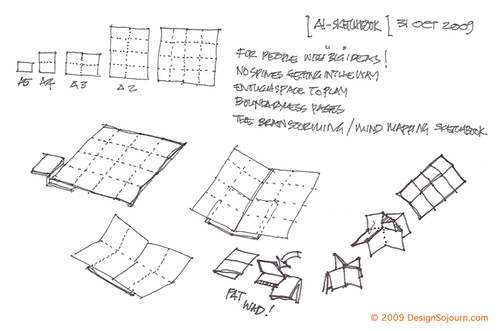
I plan to produce two versions. One is an A6 sized book (on the top) that expands into an A3 page. The other is an A5 sized book that expands into a good-sized A2 page. I will eventually produce both versions, but due to budget constraints I can only start with one. That’s where I need your help; I need to know which size resonates with you the most?

Spaces-for-ideas-final03
Let’s take a look in detail with the A6 version that expands into an A3 page. The A6 version sits nice and tight in my hand. Both A6 and A5 versions has 5 pages folded into a form fitting package.

Spaces-for-ideas-final04

Spaces-for-ideas-final05
I did not like the inside texture of the cover, so I’ve asked the supplier to line the inside in the same material as the page. Due to the construction, the inside lining extends and becomes part of the spine’s material as well.

Spaces-for-ideas-final06

Spaces-for-ideas-final07
There you go, expanded into its full A3 glory!

Spaces-for-ideas-final08

Spaces-for-ideas-final09
As you can see from the first page, the hump that was a problem in the previous prototype is now resolved, by reducing the total number of folded pages from 20 to 5. This also allows me to product a cheaper solution that you can buy in bulk. This creates a situation where you can dedicate each expandable sketchbook to a project.

Spaces-for-ideas-final10
The 2nd page expanded and unfolded, between the 1st and 3rd folded pages.

Spaces-for-ideas-final11
As you can see the A5 version is a little bigger, but it is still a tight 5 page (folded) package.

Spaces-for-ideas-final12
Here it is unfolded into its full A2 glory. This is great for creative people looking to do large mind maps, brainstorming in groups, and generally not afraid of big ideas!

Spaces-for-ideas-size01
So lets look at how the both sizes compare? The A5 to A2 version sits above the A6 to A3 version. I’ve brought back my iPhone and 15 cm ruler to give this comparison exercise a sense of scale.

Spaces-for-ideas-size02

Spaces-for-ideas-size03

Spaces-for-ideas-pac01

Spaces-for-ideas-pac02
Just in case you are interested, each sketchbook will be shipped in a sturdy and bubble padded envelope.

———-

Right, so what do you guys think? Which one will you likely go for? I await your feedback and comments with baited breath!

The next step after this is I will finalize the production volume, costing numbers and hopefully start taking pre-orders! I hope you are as excited as I am to bring this “baby” into the world.

This product has launched! Get your sketchbook at the Spaces for Ideas Store now!

Spaces for Ideas: The Brand

This product has launched! Get your sketchbook at the Spaces for Ideas Store now!

spaces for ideas logo

If you have not already, do check out the earlier posts first as they will give you a greater insight on how this design came to be.

1) Spaces for Ideas: The Beginning

2) Spaces for Ideas: The First Prototype

It is time for a long overdue update on my Spaces for Ideas Project. This time I like to share with you the brand that I am building for this product. I have always been a strong supporter of branding and this time around it is no different. Understanding the value of branding, motivated me to create a log that could communicate instantly what Spaces for Ideas was all about.

I started out speaking to a few graphic designers and branding houses, but due to cost issues and not having full clarity what I wanted, I decided to put the money into my product and carved out some time to really thinking about this brand. If I did not know what I wanted, budget was likely going to be wasted. However as I got deeper into it, I realized I was enjoying the process, and decided to take it all the way to the end.

So without further adieu please have a look at my brand development process after the jump. (Warning picture heavy, but image size managed). Oh by the way, I’m no typographer, so I would love to hear your feedback and ways I can improve the final design.


I started out with an objective of creating both a brand name and a brand icon. I saw naming and logo creation, as a combined activity as there was a chance that the name itself could become a logo. As with all of my design development activities, I often approach it from a commercial angle by establishing a marketing tagline or elevator pitch as part of my design brief. This gives me a good idea of what this logo or product has to stand for. (Top right)

I also like to anchor some basic descriptor keywords in my brief to further flesh out the design direction for the brand. I wanted Spaces for Ideas to be simple, clean, minimal (reflecting the product’s industrial design) and not look like the typical web 2.0 “chicklet”. I also wanted it to have, what I like to call, the “Fedex Arrow Effect”. This logo had to represent what the product stood for in a clever and but almost cheeky way. Before I forget, I also had to consider my functional constraints. This logo also has to be able to be de-bossed as well as fit the usual range marketing collaterals like name cards, with compliments slips etc.

After settling with “Spaces for Ideas” as a brand name I started to look at how the logo icon can succinctly represent that brand name. As you can see, some of my initial ideas stylizing how the sketchbook worked.


I took the most obvious route with this logo design. I needed to somehow represent a “space” with an icon. Easier said than done. A space is essentially that, a void filled with air. Taking up the challenge, I explored some ideas, where I cut up some font lines and used a human’s ability of “closure” to fill in the blanks. I soon settled on a concept that uses the interplay between positive and negative space.


I quickly mocked up the concept in Illustrator to see how it would look like in a controlled manner. I did like the paint lines very much, but this is not a design that is going to work de-bossed.


I realize, after playing around in Illustrator for a bit, I was stuck at a dead end. Also illustrator was not a program for me to design easily in, so back to the drawing board or sketchbook for that matter.


I continued to explore the meaning of “Space” with known representations like mountains and hills. Unfortunately all the concepts still lack the impact I desired.


Hey an empty box is a “space” to put stuff in right? I seriously considered using perspective lines to mark out a “space” before an object is drawn into it.


More box inspired concepts, this time with the words to represent lines. Ugly.


Even more boxes. I’m really struggling here!


I even experimented to cutting words horizontally in half. People only read the top half of the words anyway. Still this concept did not give me that Fedex effect I wanted.


I need to break out of this box thing. So I started to brainstorm other representations. A good one that I liked was how empty space was created between a bookshelf. (Bottom left) So Space is created between things. However, if I articulated a bookshelf as my logo would be just amateur work as it has little relation to my product. However liking the bookshelf concept very much, I parked the idea in the back of my mind and continued to explore.


As you can see, I’m still struggling to break away from boxes. I thought these box hole concepts might do the trick, but a box icon was a pretty common thing to find in logos. (I did some online research on the number of logos that had a box in it, and it was a lot!) Overall it’s still not good enough.


I finally realize that it might be near impossible to create a logo icon to represent “space”. So I went back to the tried and proven: Typography logos. That is when it hit me; the Bookshelf concept combined with typography produced a word with each letters representing a book.

I knew I finally got it. As with most solutions in design, you just know when you got it.


I wrapped up the concept phase by creating a definitive sketch of the design. This is something I also always do, as it catalogues one clear sketch to represent the concept or idea. Always as a precaution, it is also always a good idea to list the keywords from your design brief to make sure that the final logo matches your design objectives.


Time to select some fonts with the help of my keywords in my design brief. Also, I like to quickly thank a number of you who recommended font sites to visit on my Twitter stream.


I continued the refinement by picking a font and explored some placements. Slotting text in between other text has potential readability issues. So I really need to make sure I refine this direction well.


I selected the best potential arrangements and applied them 3 fonts that I short-listed.


So late one night, at 2.55am, I jumped out of bed with a solution to what I think is the best arrangement. This final layout (above) naturally aligns to how people read. “Spaces” is read left to right, and then “for ideas” read from top to bottom. If you notice, I went with a much cleaner font, even though I like to the first one I used that had “spaces” on each character. I felt that made the font look too busy and complicated.

All in all, I really enjoyed this brand creation process, and I hope you did to. I find it interesting, how much I could apply some of my Industrial Design methodologies, such as looking for insights to the natural behavior and expectations of people, to this logo exercise. I think understanding your process and the application of methodologies are key to success of any design, not just a logo design. Finally, as mentioned in the beginning of this post, look forward to hearing your comments and feedback.

Edit 2: Check out the final installment of this project, Spaces for Ideas: The Final Prototype.

This product has launched! Get your sketchbook at the Spaces for Ideas Store now!

Spaces for Ideas: The First Prototype

This product has launched! Get your sketchbook at the Spaces for Ideas Store now!

If you have not already, do check out the earlier posts first as they will give you a greater insight on how this design came to be.

1) Spaces for Ideas: The Beginning

Here we are finally, pictures of my first prototype for the Spaces for Ideas sketchbook! But before I get ahead of myself, let me pick up from where I left of in the last post Spaces for Ideas: The Beginning.

If I know you clever reader, you would have realized 2 things about the first post. First, the post was fairly generic and second I did not really set out a concept direction I wanted to go for at the end of the post. The reason was because I wanted to build up a background story around my thought process.

So as a recap here are some of the key elements I think the ideal sketchbook should have.

1. A sketchbook that highlights the work and not itself
2. Well constructed and affordable
3. No spines getting in the way of cross page sketching
4. Just the right size but with enough space or room to play with
5. “Boundary-less” pages
6. Flexible enough to do what you will
7. Decent quality paper that takes all non-wet mediums like ink, pencil or markers.
8. Appeals to everyone, not just designers

Unfortunately, I’ve learnt very early in my career that if you threw everything you wanted into a product you just end up with a mess. Thus my quiet objective in our discussion in the first post was to really prioritize which elements were important and in what combinations should they be built in.

I decided that the first of my 7 sketchbook solutions (yes 7!) would focus on creating a sketchbook around point 4-6. After a lot of thinking, sketching, and working in an iterative manner, the “expandable” sketchbook concept was born. What really amazed me about my process was this concept eventually inspired the name for the entire brand collection: Spaces for Ideas.

So now, lets take a look at my first prototype, which was incidentally an EPIC FAIL! Heh-heh. Hmm maybe I should have built a better quick mockup? Make many mistakes, but make them early!

This A6 sized book is ah…way too thick. It contains 20 pages of good quality 100gsm bright white, lightly textured paper that is quite nice to write on. Furthermore the book’s A6 size in proportion to the thickness makes it feel more like a pocket dictionary or bible. Grab your nearest one and you will know what I mean. It is a beast!

Here is the trick of this concept; the A6 sketchbook unfolds out into a generous A3 page. The sketchbook’s binding solution was a bitch to work out, as the folded A3 sheet becomes a thick wad that is about 6-7 times thicker than a single sheet. So the 20 folded pages inflates itself into something like a 120 page sketchbook. While my Binder is not much of an origami expert (the page unfolded upside down), he managed to figure out how to stuff those thick wads of paper into a book!

Here is where the biggest problem lies. The 20 sheets of folded A3 paper creates a large “hump” under the first unfolded sheet. This really spoils the drawing/writing experience.

Well that’s all from me for this update on Spaces for Ideas. I think you can easily see from this prototype that there are a lot of obvious problems that needs to be solved. Therefore almost immediately after studying it, I went ahead to brief the Binder on what to refine. Luckily, they will happy to make me another prototype.

Just as a teaser, I actually have the final prototype right here in front of me and it is looking great. There is still a lot to do, so please bear with me? I will share the next update after I work out a few more issues like branding and logistics. As usual I look forward to your comments and please do keep in touch?

Edit 2: Check out the next installment of this project, Spaces for Ideas: The Brand.

Edit 3: Check out the final installment of this project, Spaces for Ideas: The Final Prototype.

This product has launched! Get your sketchbook at the Spaces for Ideas Store now!

Spaces for Ideas: The Beginning

This product has officially launched! Get your sketchbook at the Spaces for Ideas Store now!

Spaces for Ideas: Expandable Sketchbook

After using my Moleskine for almost a year, I realized what I thought was the world’s best sketchbook was not even close.

The cover often bends out of shape, the spine makes my pages shift like a deck of cards, and it contains pages so incredibly thin that pretty much everything goes through it. While no sketchbook is perfect, I believe my fairly harsh critique was influenced by price and marketing/branding of a Moleskine. In other words, I expected something better considering how much I paid for it!

This got me thinking; while no sketchbook is perfect, just what did I not like about the Moleskine or even sketchbooks in general? I thought about all the problems I had with sketchbooks, and after that made a list of key points of what I thought my dream sketchbook would be like. And like any typical designer, I knew from that moment I could design one that was better. I hope!

1. A sketchbook that highlights the work and not itself
2. Well constructed and affordable
3. No spines getting in the way of cross page sketching
4. Just the right size but with enough space or room to play with
5. “Boundary-less” pages
6. Flexible enough to do what you will
7. Decent quality paper that takes all non-wet mediums like ink, pencil or markers.
8. Appeals to everyone, not just designers

I started, like I do with all design problems, sketching out my ideas and possible solutions.

Spaces for Ideas: Expandable Sketchbook

Spaces for Ideas: Expandable Sketchbook

At the same time I worked my sketches, I went out to do research as well as contacted a Printer/Bookbinder. I also knew I had a new “language” I needed to learn, and the Printer was a great help! I also went out to bookstores and art shops (even Muji) and bought a number of sketchbooks that had elements of the look or construction I wanted in my design.

Spaces for Ideas Sketchbook - Research Material and Mockup

I finally settled on a couple of directions, and practicing what I preach, I quickly built a mockup (top left in the picture above) over a weekend. I actually took a video of it, but I’m not sure if showing it will give you the right impression of the design as it was really rough. But for personal consumption, any quick and rough mockup the better as it got me going and better understanding the problem.

Spaces for Ideas Sketchbook - Mockup Study 01

Spaces for Ideas Sketchbook - Mockup Study 02

Spaces for Ideas Sketchbook - Mockup Study 03

Spaces for Ideas Sketchbook - Mockup Study 04

Spaces for Ideas Sketchbook - Mockup Study 05

Spaces for Ideas Sketchbook - Mockup Study 06

Spaces for Ideas Sketchbook - Mockup Study 07

Frequent visits to the Printer/Bookbinder really helped, as she showed me the ropes, taught me the “language” they used and the in’s and out’s of bookbinding. I’ve only scratched the surface, but I’ve learnt a lot. In design it is always good to be really close to where the product is made. I’ve changed the design so many times after learning about the manufacturing constraints and seeing so many other options I could use (see a samples above). In fact many things I thought I knew about printing and bookbinding were actually myths.

Finally, after a lot of exploration, testing, discussion and brainstorming with fellow designers, friends and family: “Spaces for Ideas” was born! While we are talking about sketchbooks here, “thinking big” pushed me to envisioned Spaces for Ideas far beyond just sketchbooks. I won’t share everything here today, but I like to say that I’m really inspired by this brand name as it’s very apt don’t you think? I’ve even bought www.spacesforideas.com!

Well do stay tuned, as I’ll be in touch with a blog post of the actual prototype of the design I’ve decided to develop in the next week or so. I’m sure you can pick up clues in this post, but I would like to keep it as a surprise for you for next time. Meanwhile, do leave me your thoughts and feedback, as I love to hear what you think?

Edit 1: The next installment of Spaces for Ideas: The First Prototype is up!

Edit 2: Check out the third installment of this project, Spaces for Ideas: The Brand.

Edit 3: Check out the final installment of this project, Spaces for Ideas: The Final Prototype.

This product has launched! Get your sketchbook at the Spaces for Ideas Store now!

Post Occupancy Design – Life after the Designer

Entrepreneurship
Jul 21, 2008

Domus Magazine has recently launched a signature edition offshoot called Domus d’Autore. This first issue, entrusted to Editor-Architect Rem Koolhaas, was designed to allow readers to listen “…to the voice of those who know how to look beyond current confines and have the strength to direct and influence our way of perceiving the city and the spaces beyond it.”

As usual the magazine focuses mainly on Architecture, but Imomus has highlighted one of Rems theories that can have an interesting application in Industrial Design.

“post-occupancy design” — the stuff that happens to design after it’s left the designer’s workshop (and architecture after it’s left the studio) is the real test of its quality and character. Occupancy and use shouldn’t see the designer and the architect melting away. They should stick around, take notes, and take photos. The processes of time and decay can be beautiful. The way people use stuff and adapt it can be instructive.

un-p3 project

Very well put. Furthermore my regular readers would recognize “Post-Occupancy Design” as similar to, amongst other things, what I have been exploring in my Un-p3 Project (Yes it is till happening!). I wanted to create, through the use of materials, an object that reflects this process of “time and decay” and how it can be beautiful, something that I think iPod/iPhone owners lament angrily over when they are clean polishing their shiny screens or chrome backs.

But is this another trend coming full circle?

It is funny. Our shiny PSP/Mp3 Player/Mobile Phone/Laptop products of today seem to prioritize looks over product engineering fundamentals of case-part protection from the environment, long term usability and product life deterioration. Even more surprising, is the fact that these are portable products. Perhaps that is why the protection accessories market is big business? But hey, would you want to use the heavily textured, dark grey plastic Palm PDA of ages past?

Well, my curiosity is piped, and I’m off to get the Magazine…

The Un-p3 Project Update

Entrepreneurship
Nov 25, 2007

brian- ling-un-p3-project

It has been a good number of months since the I’ve last updated my readers on the status of this project. Firstly though I like to apologize to a few of this project’s supporters for this delay but I have not been idle and was working on it during my spare time. I really was waiting for this time to finally give you an update.

Most of you astute readers would have already noticed that The Un-p3 Project is currently being exhibited at the Dandelion Industrial Design Exhibition. Unfortunately due to the entry criteria, that exhibition is really only for “show”. Therefore I thought to continue and expand upon the “tell” part here at Design Sojourn. This will be a great opportunity for you to ask any additional questions or make comments of any kind. Also I get a chance to explain how I went from the Haptic concept, and came up with the Wave one.

un-p3-project-haptic-concept
The Un-p3 Haptic concept: For more information see links below

If you missed the original conceptual thinking of this project that I am self-developing in the role of a design producer do take a look at Part 1 and Part 2 first for some background information, especially on the above Haptic concept.

I have to admit that it has been difficult realizing this project and even at this stage we are not totally done. After speaking to more designers about the Haptic Concept, the deeper complexities of my objective of this product’s creation process became more evident. So I wondered, perhaps unsatisfied with the current use of wood, that perhaps I should open my thoughts to consider other forms of craft manufacturing type techniques? But there is this problem going the craft route.

You see the when we look at craft vs manufacturing scale below they are actually polar opposites of each other:
craft-vs-manufacturing
The Haptic concept tends to fall on the more craft end of things, and I would rate the Wave concept as in between the two.

Craft manufacturing tends to focus on one off products or small production runs often hand made, but as a result often suffers from tolerencing and perhaps reliability issues. Mass manufacturing strives on standardization and volume, thus the products will have good fit but you need to sell in the numbers. As the project’s experiment was about exploring the use of craft based manufacturing juxtaposed with an electronic product, we need both small volumes, attention to detail, but still have good part fit.

One day while speaking to some friends working on their design project, I had a “euraka” moment. Why not use a Rapid prototype machine? Not only does it allow me some freedom in design (well almost, the RP machine still has restrictions) but it also allows fairly good tolerancing and part fit that is perfect for building electronic products.

So as I got started and studied the creation process via the Rapid Prototyping Machine, I decided very quickly that I had to designed this concept so that it would be difficult to be reproduced via mass-manufacturing. Undercuts, flat edges, thin walls, narrow gaps, living hinges and surface texture were tricks that came into play below.

un-p3-project-wave-concept
The Un-p3 Project: Wave Concept

So there you go, the Wave concept. I have to say though it was a very interesting experience as after more than 10 years working on Industrial Design programs, certain manufacturing “givens” like part line placement or designing for draft have been ingrained in my creative creation process. In creating this Wave concept, it required me to spend a few days re-thinking and re-framing what I know about design for manufacturing before I could even set my mind free. I hope you enjoy reading about this project as much as I did creating it.

So if you had a choice on which direction would appeal to you, if I made a limited edition run of 20 pieces which would it be? Perhaps I may do a 10-10 split? Regardless please do have your say and I look forward to all your comments.

Entrepreneurship is really all about a Mindset

Entrepreneurship
Jun 18, 2007

I’ve always considered myself resourceful and entrepreneurial even though I have always been an employee. I’ve always wondered about that? Why is that I don’t see the need to leave my day job to be an Entrepreneur? In reality this post is not about justifying my place in life, but the fact that what people consider as the traditional characteristics of an Entrepreneur is no longer relevant in today’s economy that has the Internet as a medium of information transfer.

Thinking carefully on this issue, I’ve realize that Entrepreneurship is really about a mindset more than anything else, and a successful entrepreneur is more about the definition of what success is. Honestly there is no difference between selling your company to Google for 100 Million and selling 100 pieces of your beautifully hand crafted mobile phone pouches.

Let us now consider my usual slightly deviant, “of the beaten path” view points on this matter.

[ more ]

The Un-p3 Project Part 2: Prototype Samples

Entrepreneurship
May 20, 2007

Edit: Re-formatted the layout of some text and images.

Yep. There is no point me blogging about doing good industrial design or design theory if at the end of the day I don’t walk the talk and produce something to show, right? Well after starting, stopping, re-starting, hacking and spin drying my ideas, I have finally succeeded in creating sample prototypes of my Un-p3 Mp3 player! Can you say that five times in your head?

Please do check it out after the jump and please leave me all your hard hitting ego killing feedback? No hang on, my ego is fragile so please be gentle? Heh-heh.

[ more ]