


Do I have to be able to draw well to be a good designer?
This by far, is one of the most frequent questions designers always ask of me. Furthermore, “I can’t be a designer cos I can’t draw” is also one of the most frequent reasons people give for not being a designer or any type.
I myself had to deal with this when I started my career in design as my sketching skills at that time were very poor. However, after almost 10 years in this business, I like to give my take on this perennial question.
What is pretty unbelievable is that I have seen famous designers (who shall remain nameless!) create terrible sketches but end up with great designs, and great sketches that are hopeless designers.
Therefore my answer to this question really is “Yes” and “No”.
Essentially you would only need to draw or sketch well enough to communicate your concept on paper without you having to explain what it is. You don’t have to win the beauty contest, but you WILL have to do well enough so that a fellow designer (or if you want it to be tougher on yourself, a non-designer) can understand what you are attempting to communicate.
Notice the key word here? It’s not drawing, draw, design, or sketch, it communicates. A good sketch communicates an idea clearly and succinctly.
Sketching is also one part of the design process that makes up a successful design. Strong understanding in proportions, colors, and manufacturing processes are other important elements that can make or break a design. So don’t despair if your sketching ability, at this time, is not up to par, as you will have a chance to refine it in the downstream design process.
Before we go on let us take a look at the different kinds of sketches so as to not confuse yourself when you go crazy over somebody’s apparently great work.
Thumbnail or Napkin sketch

A thumbnail sketch is a very basic sketch that has an almost childlike quality to it. This type of sketch is mainly about getting your ideas down on paper as quickly as possible without too much care about proportions and beauty. It is often pretty rough focusing only on the key “big” idea. Thumbnails sketches are often the most frequently used sketch technique used to communicate ideas.
You can learn more about the importance of thumbnail sketches here at Steelcase’s 360 E-Zine.
Emotion Sketch

Source: Mikedesign
Emotional sketches are the main source of what I like to call “sketch discouragement”! These are the sketches people go ga-ga over and the main source of a designer’s spine-tingling sensation as well as frustration. Also called Inspirational sketches, such sketches are often used to set the tone of a design, brand language or product range.

Source: Toyfon
Emotional sketches are also very difficult to do. Simply because an emotional sketch is extremely form orientated, and used as a means to communicate emotion. Hence the designers who create emotional or inspirational sketches are often called “form monsters” and have the uncanny ability to turn an emotion or expression keyword into a line, form or silhouette.
However, one if you look closely into such sketching style you would realize such sketches don’t actually communicate a lot of information. If you look at the example above, can you ask yourself how does the door open? Where is the door handle? The side mirrors?
It’s because such sketches are meant to convey just the look or feel of a product and nothing more. It intentionally or unintentionally leaves out things like mechanical fixtures, part lines, or assembly information etc. The best emotional sketch designers are actually able to convert their sketches into great products, but unfortunately, you be also surprised to know most cannot and remain in just form or concept development.
Information Sketch
The information sketch is perhaps the level at which what most designers, who are worried about their sketching ability, should aspire to. It’s the minimum type of sketch level that would allow other designers to understand what you are trying to draw.
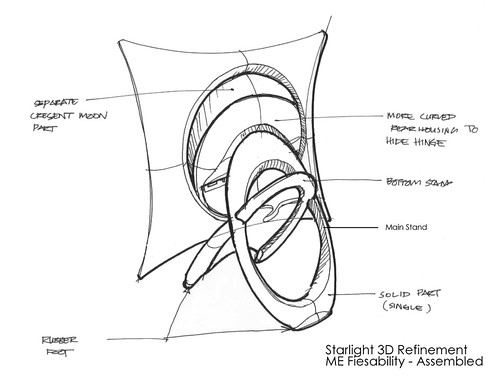
I drew this to describe to my client’s engineering department, how the design’s different parts all came together.
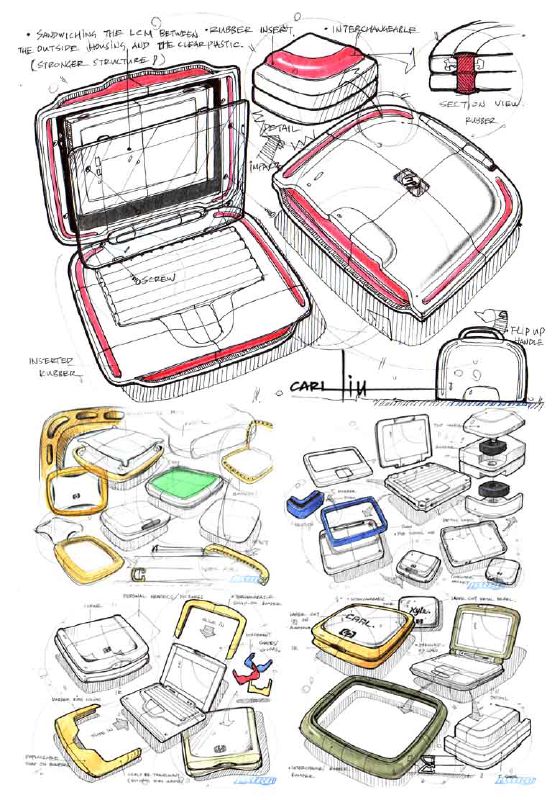
Carl does probably some of the best informational sketches I have seen. Waaay better than mine! Source
There are a lot of tangent lines, exploded views, transparent layering, a little color here and there, but all in all you can easily tell almost right away what is going on.
Right now so how do we do it? How do we get to the level we are satisfied with? Or how do we just improve our sketching ability?
No gentle reader I will not leave you high and dry! Tomorrow, in part 2, I will list 10 tips that has helped me improve my sketching ability! So do stay tuned and please keep in touch!
Thulasizwe Mike Dlamini
January 23, 2016 at 6:13 amHi My name Mike from South africa, I’ve been drawing ever since I was a kid so passion is what I have and ever had for car designing, I could carry on with my studies cause there were no car designing schools. I’ve never attended art school but it was the love I had of drawing cars and laying them In diferent views. So due to life situations I had to sort out my life as it is now, if I may find a way through of doing what’s taking me to my dream of becoming a car designer I’d go for that. Now I’ve been upgrading my Maths so I can persue my dream, I kindly need your help if possible. Thank you for giving yourself to read up my comment. Kindly need a reply
KIMSANGHYUN
November 7, 2010 at 5:30 pmIt needs high level of drawing..
Juan Fandiño
July 4, 2010 at 6:41 amHi its an interesting and educating post, I’ve allways hear that question from many people. A Teacher said: You can have ecxellent draws but that doesn’t make you an ecxellent designer, the importance is how you represent your ideas. Im a venezuelan student. I have a little blog http://fandinhodesign.blogspot.com/ check it out!
Alyssa
September 18, 2009 at 7:27 amHi,
I am a senior in college majoring in graphic design and I can not draw. Yes, I can sketch my ideas on paper, placing type and such on to the page and draw thumbnails, but I am no “artist” in the sense of drawing. I am creative I have many ideas for all of my assignments and I put them all on the computer. My graphics teacher never asks us to sketch our work first, but my typography teacher always did. My drawing teacher also believes graphic designers need to have some ability of drawing. To me it’s personal preference, but I also think anyone can make up a sketch. It doesn’t have to be perfect it just has to get your point across clearly to the client who isn’t a graphic designer. I was also discouraged about drawing when many people kept telling me you have to be able to. I can not create beautiful artwork with a pencil but I can make a killer design on the computer and I’m proud of my work and will have a career as a Graphic Designer! and so will and so have many others that can not draw well.
Michael
May 23, 2009 at 9:18 pmi don;t know if anyone has ever asked this…. im thinking of starting up my own blog and blogging about this…
why is it that all designers handwriting looks the same? I admit i write the same. could one say the same about all doctors? is it something inherent in who we are? maybe its genetic :p and why is it we all have such appreciation over arrows in sketched…i spent years perfecting different forms of arrows trying to find ones which communicated my ideas the best. what is the fascination or was it always just me?
tthomkatt
July 18, 2008 at 7:33 amha ha, do i have to be able to draw,, the answer, is… only if you expect to graduate…
alison stedman
July 8, 2008 at 4:27 pmI work as a designer in a technology centre dedicated to design and technology in schools. It is the perennial question – is sketching neccessary? Yes and I believe it needs to be taught. To me personally the napkin sketch (which my husband did many of in our art college days )says more to me than the emotional sketch (though they are beautiful) but you can always employ an illustrator to do them. Sketches don’t have to be works of art they are in many situations working sketches which is a very difficult concept to get over to children who still want to do a perfect drawing in the middle of a page.
DT
October 4, 2007 at 9:14 pmHi Sahar,
Thanks for your comments.
Sahar
October 4, 2007 at 3:41 pmThanks for all thise informations!
Design Translator
December 9, 2006 at 8:31 amHi Spencer,
Thanks for your stopping by and your comments.
Actually, I did not say its a bad design. Please re-read my comments: I said “it not the most exciting design”. I apprecieate the authors ability, and this sketch is used as an example of how sketching is all about a technique and not so much an inbuilt pre-born ability. Edit: Picture in question has been removed, apolgies to Spencer for any unhappiness caused.
This article is also to encourge budding designers that its about communication and acquring the skills and not being the end all and many designers insist.
In response to your last paragraph, i also like to point out what about industrial designers who work in case part design? They determine partlines, proper shelling and location of draft angles. They hardly draw and most of the work is in 3D CAD, do you not consider them designers as well?
The design process is a long one, and my take off this is a designer can be part of any of the process he/she feels comfortable with.
Spencer Nugent
December 8, 2006 at 11:43 pmMaking the assumption that the mixer is a bad design is wrong because it is not fair to judge the design without knowing the context, user or appropriateness of the object. What makes something a good design is if it is appropriate for the user, functional and also beautiful.
Beauty can also be purely functional. Simplicity in function is beautiful. Perhaps this mixer is appropriate for a particular user under certain circumstances, therefore making it a good design. Judging a design soley on aesthetics is juvenile and leads to subjectivity rather than objectivity when evaluating the design.
Sketching does not make the designer. You are right. However just as much as a salesman must hone his communication and personality skills in order to make sales, so too must designers hone their visual communication skills to better sell their ideas. A man who cannot communicate his ideas effectively is on the same plane as one who has no ideas in the first place.
Design Translator
December 8, 2006 at 9:14 pmHi Aen,
Thanks for your comments and viewpoint as a graphic designer.
Hi RustyBlueMetalZ,
You are quite right, my aim of my article was to remind designers that you dont really have to be the best sketcher to be a good designer, and that sketching skills have to be put in the right perspective in the context of the design process.
At the end of the day, most designers just need to get to a level that is good enough to bouce concepts and ideas.
RustyBlueMetalZ
December 8, 2006 at 7:27 pmi’m just a student but what i see here is quite true , i have seen my fellow course mates drew alot of nice illustrations but unable to present their ideas well in their presentations because the audience can’t see how their designs works. Imagine telling a person to push a specific button in a cockpit without showing where and how. But i believe that there is a certain minimum requirement to the quality in sketching that a person must have,as even if the guy sketches alot of with low quality drawings, the other designer won’t know what he is doing.
AEN
December 8, 2006 at 5:58 pmI don’t design products but in my industry, sketching actually plays a big part in the creative process.
Almost every single design, visual, graphic, layout begins on paper. I usually keep a notebook with me on the road so I can doodle any ideas that strikes me on the fly.
Being someone who had the computer late, I like the feel of pen and paper more. Sketching should be the fastest method to turn ideas, thoughts and concepts into visible visuals. Being able to sketch well means better and more meaningful sketches, especially if the sketches are meant to be shown to someone else.
Nice article!
Design Translator
December 7, 2006 at 9:59 amHi John,
Thanks for your insightful comments.
As design moves from a execution based job to a strategic one, drawing and other technical skills like 2D/3D CAD becomes only one aspect to a strategic designer, and less important to the entire package.
However most designers with less than 5 years of experience are still judged greatly on their technical skills, as at this level this is what they are used for.
At the end of the day the design process is vast and wide, its all up to the individual to leverage on his/her strengths and decide which part of the process you want to be in.
john trenouth
December 7, 2006 at 4:08 amI’ve come across this question many times as well (http://www.niblettes.com/blog/2006/09/19/design-is-not-about-drawing/).
The answer I’ve arrived at is far more “no drawing doesn’t matter much” than “yes, it does.”
For industrial design, clearly drawing is crucial not only to communicating design ideas, but to formulating them in the first place. However ID is only one flavour of design. And even in ID drawing is necessary only to the problem solving phases and not the problem definition phases.
This doesn’t even touch the issue of drawing skill. For example, showing the problems with how customers move through a retail space is adequately accomplished with mere stick figures. The idea being communicated is flow, which is as an abstract idea, which are often obscured by visual decoration.
I guess my point is that as design is redefining itself beyond traditional industrial and graphic design, drawing–and certainly drawing skill–are becoming less important to the field overall.